Life Sciences Research Support
Perfect writing doesn't necessarily make you shine in grant writing
But clarity matters!
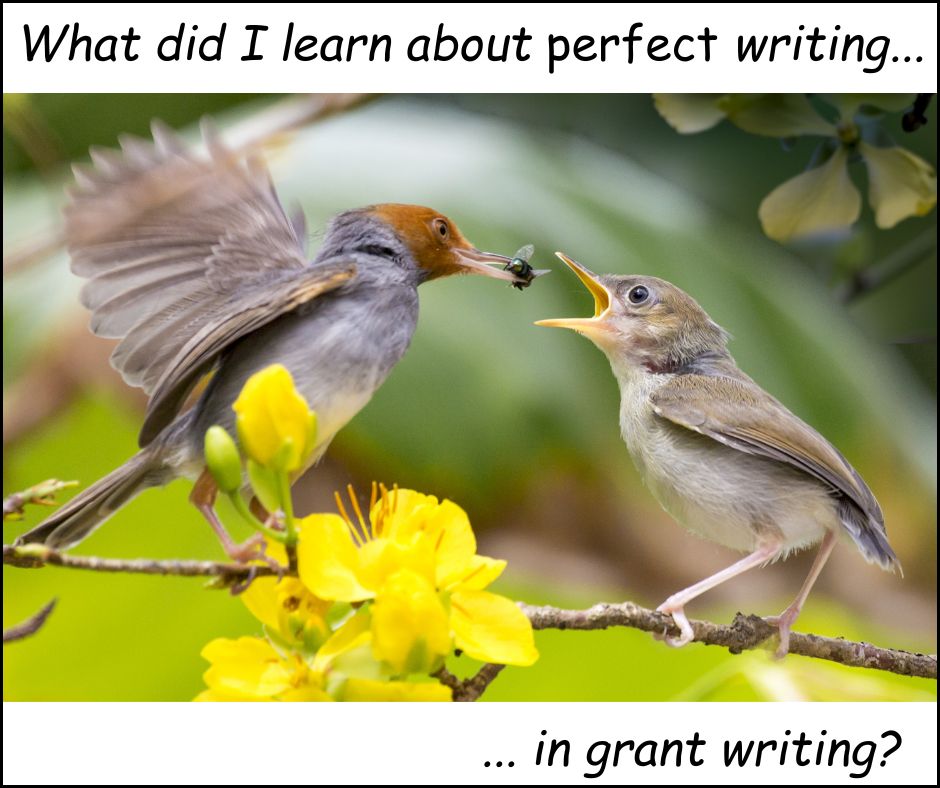
Figure caption: The bug doesn’t have to look perfect, but it does have to be what the receipient expects!
When I started my career in the sciences, I thought that both professional grant writers and principal investigators were excellent writers. I thought they had a perfect understanding of English grammar and style.
Why perfect English isn’t required
However, most people in Europe actually aren’t native English speakers!
Europe is made up of a myriad of relatively small countries, each with its own language. Some European countries, like Belgium and Switzerland, even sport 3–4 official languages!
This means that many scientists and innovators born outside of English-speaking countries learn to speak English some time after they were already in school. Some even begin learning English at the university.
On top of that, scientists and innovators often move across the globe because they want to be where opportunities are. This ends up transforming Europe into one giant melting pot full of diverse nationalities, languages, dialects, and cultures, mingling together at the office, at pilot plants, and in the research labs.
So, what this all means in grant proposal writing is that perfect English isn’t a prerequisite for submitting a stellar proposal.
Why does clarity still matter?
However, you still need to make sure that grant proposal evaluators can understand your English! This means that clarity in your writing still matters.
That seems like a pretty easy guideline to follow, but we scientists and innovators have a really hard time complying with this simple rule.
Here’s why.
When formal writing backfires
We scientists, engineers, and other technical folks at the forefront of scientific breakthroughs and innovation love using complex sentence structures when writing grant proposals, white papers, and research manuscripts. We were essentially trained to write formally.
However, this emphasis on formal writing can backfire dearly, especially for many junior professionals and non-native English speakers.
This is because their efforts to write formal English can make their sentences overly complex and convoluted. What happens next is that readers don’t understand what these authors are trying to say.
Example of a convoluted, grammatically shady, overly complex sentence: “The dissemination activities, which will be coordinated by the responsible partner for engaging stakeholders, some of whom will be from industry, with gender equality taken into consideration, and which are intended to ensure that the technologies developed during the project can be communicated not only to academics but also to relevant policy actors, will be developed during the first six months of the program.”
The result of complex, convoluted, and error-prone grant writing is that grant proposal evaluators won’t fully appreciate the narrative within proposals they don’t understand.
The other extreme is also a problem.
When simplicity also backfires
If you write in overly simplified English, the narrative can end up sounding informal and even unprofessional. It also loses clarity.
I’ve seen this writing style in many manuscripts I’ve edited in the past that were written by English-as-a-second-language (ESL) authors who had difficulty communicating in English. Such authors tend to write staccato series of 5– to 6-word sentences with only a few transition phrases to string the narrative into proper storytelling.
Example of an overly simplistic writing style: “We will coordinate the partners. Females will be taken into consideration. Policymakers will be taken into consideration. Additionally, academics will communicate with other stakeholders. This will be very important.”
In this example, you might notice that the sentences contain a few relevant keywords. However, it’s difficult to understand which concepts are connected and which ones aren’t. You might also spot a couple of other jaw-dropping phrases that could get evaluators questioning your ethical tendencies and get this proposal thrown into the reject pile.
Therefore…
Here are my suggestions for writing a good grant proposal:
Write formally, but keep your sentence structure reasonably simple. Avoid embedding too many clauses within each other.
Always write for your readers, not for yourself. Self-centered writing is what makes proposals so difficult to read.
Check your grammar and punctuation using a spelling and grammar checker like Grammarly before submitting your applications, unless you want angry reviewers fuming about sloppy writing and forgetting to assess you for your science and innovation.
~~~~~~
Hi! I offer grant writing and science writing services to scientists, nonprofits, innovators, and educators in agrifood, life sciences, and sustainability.
DM me to schedule an exploratory call. We’ll discuss your specific needs and find solutions to get you rolling.